
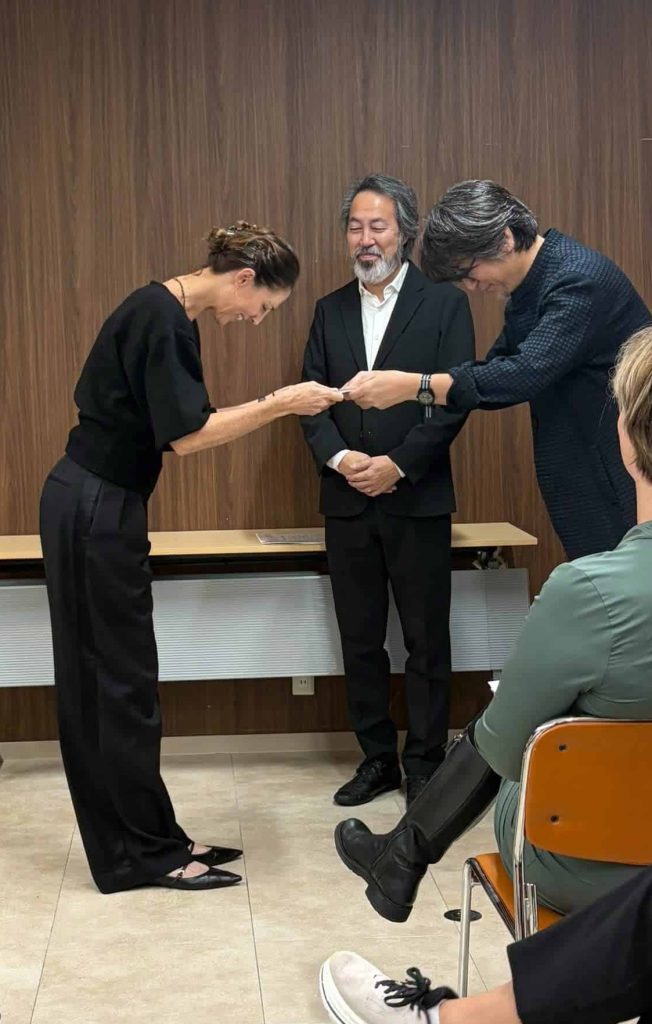


I went to Japan for a Technique
When I decided to go to Japan to study acupuncture, I thought I had a clear picture of what that would look like. I’ve been in practice long enough to know how continuing education usually looks like. Notes, photos of slides and you go home with something new to try on Monday that gets blend into your practice and probably gets forgotten by the next month . That’s not what happened in Kyoto. I found a different way of looking at this medicine, and it changed how I think about the work that I’ve been doing for years and how I want to blend Western medicine and Energy medicine.
Table as a Shrine
On my first day, before I’ve seen a single technique, I was introduced to Shinto. Shinto is Japan’s spiritual tradition built around the idea that deity lives in nature, mountains, rivers, trees, and in the ordinary world. It is not a medical system that gives Japanese acupuncture its theory, but it explains what guides a great deal of the manners around Japanese Acupuncture. How you move around the treatment table, how you carry yourself near a patient and how you approach every encounter is guided by the principle of respect and service to the other.If a patient lying on a treatment table carries the same divinity the natural world itself then how can we look at it as just a set of symptoms to fix? The consultation transforms into a unique once in a lifetime encounter that deserves respect and intention from the us. When a patient is sacred in nature, you can’t hurt them ! so avoiding pain is not just a courtesy, it’s the core principle that guides how every needle is handled.
Listening with your hands
I wasn’t new to palpation diagnosis, but in Japanese acupuncture, touch is how you gather information, and the emphasis on it is hard to overstate. You palpate to understand the body before deciding anything. You palpate to feel what the acupuncture points are telling you. Instead of simply locating a point with body measurements, you get real on-time feedback from it. This goes back to the origins of Japanese acupuncture. One of the first practitioners to transform acupuncture in Japan, Sugiyama, was blind. He came to acupuncture through training in massage therapy, and because he couldn’t rely on his sight, he build a practice around what the hands could perceived and that legacy is still present.
Back to the Classics
The third surprise was how much the study of the classics matters. Yin Yang and five element theory aren’t treated as historical fiction, they are the working framework of diagnosis and treatment and this reorders priorities. The root cause of a dysfunction is always analyzed through the five element diagnosis and organ imbalances. I saw a big emphasis on addressing organ deficiency patterns with special attention to the liver organ ( AKA the stress organ), . More acute complaint like pain is considered the branch of the treatment. Branch treatments are real and useful, but they sit alongside the root treatment, never instead of it. As someone who treats a lot of pain, I found that a valuable thing to incorporate.
Ten years in
I am reaching my 10 year mark in practice and there’s an old saying in Japan that it takes 10 years just to begin learning. I always took that as an exaggeration, mostly because I would dread to go back to school at 50. Standing in front of master acupuncturists, my ego had to step to the side and it felt more like a fair description. I arrived with a decade of experience and left with a much clearer sense of how much I still have and want to learn. There’s famous line that says the only thing we know is that we know nothing, I hear you Socrates…
What I’m bringing home
Acupuncture has a foundation in science, but it is also an art. Listening to the tone of a voice, palpating meridians, observing complexion, all that plus a dose of intuition. Over the past decade, I’ve been developing my own approach. Above all, I want my practice to be safe, accessible, and effective. I stay on top of research to improve results, and I also trust the intuition that grows from practice.
I’m bringing home a gentler way of needling, so expect an even deeper acu-nap! I’ve seen wonderful results without strong needle stimulation, and I don’t see the point of making anyone suffer in the process of feeling better. If you’ve been my patient, you’ve heard me say it a million times: you can’t alleviate pain by creating pain! I strongly dislike aggressive, painful needling and I’m happy to debate the idea that dry needling gets better results. A patient breaking into a cold sweat on the table is not my measure of an effective treatment.
This trip has validated many of my instincts about gentle needling and given me so much more to bring into my practice. I can’t wait to share it with all of you!